
DOSE GUIDE
Creatine Gummies Dosage: What the Label and the Research Say
Creatine gummies dosage is a sums problem before it is a science problem. This guide sets the label directions for pr1mebody Creatine Gummies beside the figures in the research, the EU register and the safety limits, so you can see where each number comes from. We do not give personal dosing advice.
Food supplement. Not a medicine. Not for under-18s.
5 g creatine monohydrate per serving
5 gummies per serving
150 gummies per bag
30 servings per bag
Strawberry flavour
5 g creatine monohydrate per serving
5 gummies per serving
150 gummies per bag
30 servings per bag
Strawberry flavour
Creatine gummies dosage at a glance
Each line below is expanded further down, with its source.
- The label: our listing states 5 g of creatine monohydrate per 5-gummy serving, so each gummy holds 1 g. The directions say five gummies a day, any time, with or without food.
- The research range: the International Society of Sports Nutrition (ISSN) position stand gives 3 to 5 g a day as the usual maintenance intake once muscle stores are full.
- Loading is optional: the same paper describes about 20 g a day for 5 to 7 days, and a slower route of 3 g a day for 28 days. Our label says no loading phase is required.
- The EU number: both authorised creatine claims in the EU register name a daily intake of 3 g.
- The safe-level number: a 2006 risk assessment found strong evidence of safety up to 5 g a day for long-term use, and too little long-term data above that.
- The bag: 150 gummies last 30 days at five a day, or 50 days at three a day.
- The limits: the product is not for under-18s, and anyone with kidney problems, on medication, pregnant or breastfeeding should ask a doctor first.
This page explains numbers. It does not tell you what to take. For a decision about your own body, ask a doctor or pharmacist. Safety is covered in the sections below.
OUR CREATINE GUMMIES
pr1mebody creatine gummies
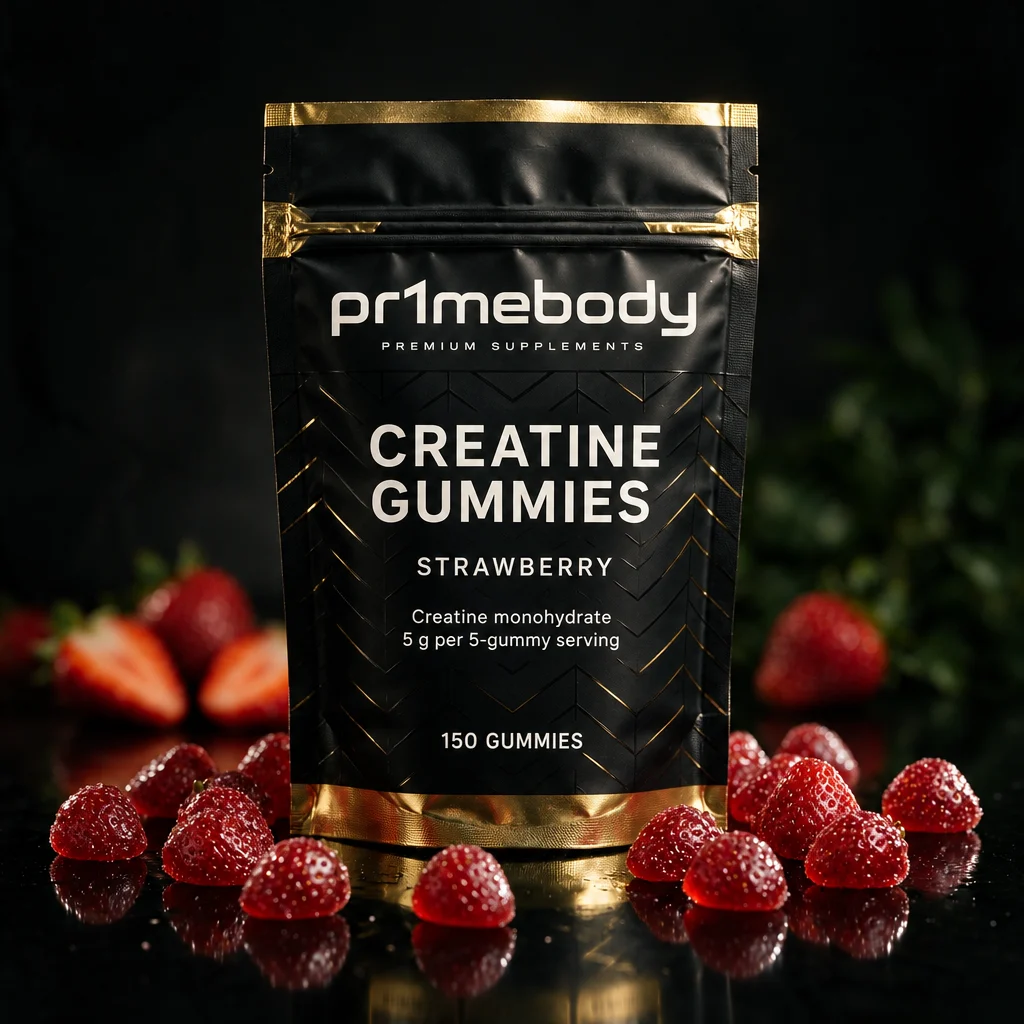
pr1mebody creatine gummies give 5 g of creatine monohydrate per five-gummy serving. 150 strawberry gummies a bag, 30 servings.
- Creatine monohydrate: 5 g per serving
- Serving: 5 gummies
- 150 gummies per bag, 30 servings
From
$53
1 bag
30 servings · $1.77 per serving
$53
Buy 2, get 1 free
3 bags
90 servings · $1.18 per serving
Standard 3‑bag pack: $120
You save $14
$106
When these are gone, the 3‑bag pack returns to its standard price.
3 bags
90 servings · $1.33 per serving
$120
Save $39
6 bags
180 servings · $1.11 per serving
$199
Save $119
Best value
12 bags
360 servings · $0.92 per serving
$331
Save $305
See the full product page · Read first: creatine gummies explained
Prices in US dollars as of 12 Oct 2026. Free tracked shipping and a 30-day money-back guarantee. Checkout opens on satiovex.com, the store run by Xinop LLC, which also sells pr1mebody products; the item may appear there under the Satiovex name.
What the label says about creatine gummies dosage
Start with the label, because the research counts grams and the pouch counts gummies. These are the facts from the product listing for pr1mebody Creatine Gummies (strawberry). Where we did the arithmetic ourselves, the table says so.
Label item
What the listing says
What it means
Label item
Serving
What the listing says
5 gummies
What it means
One serving is five gummies, not one.
Label item
Creatine per serving
What the listing says
5 g creatine monohydrate
What it means
The 5 g is per serving. Per gummy it is 1 g (our arithmetic: 5 g divided by 5).
Label item
Bag size
What the listing says
150 gummies, 30 servings
What it means
A full bag holds 150 g of creatine in total (our arithmetic: 150 gummies at 1 g).
Label item
Directions
What the listing says
5 gummies daily, any time, with or without food
What it means
The listing adds that consistency matters more than timing.
Label item
Loading
What the listing says
No loading phase required
What it means
The directions do not ask you to take more in the first week.
Label item
Age
What the listing says
Not intended for under-18s
What it means
We follow the label and give no guidance for teens.
Label item
Medical
What the listing says
Consult your doctor if you have kidney conditions or take medication
What it means
This applies to the whole directions line, including the number of gummies.
The 5 g is the manufacturer's stated figure. We do not publish an independent laboratory report on this site yet, so please treat it as a label statement. If batch documentation matters to you, contact us before you buy.
To run the same sum on another brand, divide the creatine per serving by the gummies per serving. The table further down shows what that gives across the range of label strengths seen in one industry test.
The pr1mebody pouch. Product images are illustrative renderings.
Why do sources quote 2 g, 3 g, 5 g and 20 g?
Search for a creatine dose and you will meet 2 g, 3 g, 5 g, 7 g and 20 g, all from serious sources. They are not in conflict. Each answers a different question, and mixing them up is how people end up with the wrong creatine gummies dosage in their heads.
Number
Where it comes from
The question it answers
Number
3 to 5 g a day
Where it comes from
ISSN position stand, 2017
The question it answers
The usual maintenance intake once muscle stores are full
Number
5 to 10 g a day
Where it comes from
Same paper
The question it answers
What larger athletes may use
Number
About 20 g a day for 5 to 7 days
Where it comes from
Same paper (5 g four times a day, or about 0.3 g per kg)
The question it answers
Loading, the quickest route to full stores
Number
3 g a day for 28 days
Where it comes from
Same paper
The question it answers
The slower route with no loading
Number
3 g a day
Where it comes from
The two authorised creatine claims in EU Regulation 432/2012
The question it answers
The intake an EU label has to name to use the wording
Number
Up to 5 g a day
Where it comes from
Shao and Hathcock risk assessment, 2006
The question it answers
The observed safe level for long-term use
Number
0.1 g per kg a day
Where it comes from
Antonio and colleagues, 2021 review
The question it answers
A body-weight version of the 3 to 5 g range
Number
2 to 3 g a day
Where it comes from
Kreider and colleagues, 2025 opinion article
The question it answers
A general-health suggestion from authors with disclosed industry ties
The 3 g in the EU material and the 5 g in the research are not rivals. One is the amount attached to authorised wording, the other is the top of the usual maintenance range. The directions on our pouch work out at 5 g a day: the top of the ISSN maintenance range, equal to the long-term level in the 2006 risk assessment, and above the 3 g in the EU register. That is why we show all of them.
Read the ISSN paper with one caution: its authors disclose financial ties to creatine and supplement companies. That does not make the figures wrong, but it is a reason to set it beside independent sources, such as the 2006 risk assessment and the 2017 review by scientists at the German Federal Institute for Risk Assessment (BfR).
Loading, maintenance or the slow route: what each means in gummies
Every dosing plan is about filling muscle stores, so the routes differ in how fast they fill. The ISSN paper describes the quickest as about 5 g four times a day for 5 to 7 days, then 3 to 5 g a day to maintain. The slower route is 3 g a day for 28 days. Antonio and colleagues report that 3 g a day for 28 days and 20 g a day for 6 days both ended with about 20% more creatine in muscle, and conclude that loading is not required.
Route
Daily amount (source)
Days
Gummies a day at 1 g each
Gummies used
Route
Loading
Daily amount (source)
About 20 g (ISSN)
Days
5 to 7
Gummies a day at 1 g each
20
Gummies used
100 to 140, which is 67% to 93% of a bag
Route
Slower route
Daily amount (source)
3 g (ISSN)
Days
28
Gummies a day at 1 g each
3
Gummies used
84, which is 56% of a bag
Route
Maintenance at the label amount
Daily amount (source)
5 g (label)
Days
30
Gummies a day at 1 g each
5
Gummies used
150, a full bag
Route
Maintenance at the low end
Daily amount (source)
3 g (ISSN)
Days
30
Gummies a day at 1 g each
3
Gummies used
90, which is 60% of a bag
Our label says no loading phase is required, and the arithmetic shows why. Loading at 20 g a day means chewing twenty gummies a day, spread over several sittings, and it uses most of a bag in under a week. The papers describe the slower route as reaching a similar level in about four weeks.
Splitting matters at the high end. In a 28-day trial of soccer players, a single 10 g serving caused diarrhoea more often than two 5 g servings. Five gummies is one 5 g serving. The numbers are in the side effects guide.
The ISSN paper also says it generally takes 4 to 6 weeks for muscle stores to return to baseline after you stop. That is slow enough that one missed day is not the same as stopping. This is our reading of the paper, not a finding it states.
How many gummies make a dose?
Gummy brands do not all carry the same amount of creatine. Labels in the industry test described on the main guide ranged from 250 mg to 1,700 mg per gummy, and the number you chew is your daily target divided by the creatine in one gummy.
Creatine per gummy
Gummies for 3 g
Gummies for 5 g
Gummies for a 20 g loading day
Creatine per gummy
250 mg
Gummies for 3 g
12
Gummies for 5 g
20
Gummies for a 20 g loading day
80
Creatine per gummy
500 mg
Gummies for 3 g
6
Gummies for 5 g
10
Gummies for a 20 g loading day
40
Creatine per gummy
750 mg
Gummies for 3 g
4
Gummies for 5 g
7 (6.7, rounded up)
Gummies for a 20 g loading day
27 (26.7, rounded up)
Creatine per gummy
1,000 mg (pr1mebody)
Gummies for 3 g
3
Gummies for 5 g
5
Gummies for a 20 g loading day
20
Creatine per gummy
1,700 mg
Gummies for 3 g
2 (1.8, rounded up)
Gummies for 5 g
3 (2.9, rounded up)
Gummies for a 20 g loading day
12 (11.8, rounded up)
The 250 mg and 1,700 mg rows are the two ends of that label range, and the 1,000 mg row is our own pouch (5 g per 5-gummy serving). At 250 mg a gummy, a 3 to 5 g day means twelve to twenty gummies, which is a cost and sugar load worth counting before you choose a brand. The 20 g column is the ISSN loading figure, shown for comparison and not as a suggestion.
How long does one bag last?
The label counts gummies, so it helps to translate. This table is arithmetic from 150 gummies per bag and 1 g per gummy. It is not advice on how many to take.
Gummies a day
Creatine a day
Gummies in 30 days
Days one 150-gummy bag lasts
Gummies a day
2
Creatine a day
2 g
Gummies in 30 days
60
Days one 150-gummy bag lasts
75
Gummies a day
3
Creatine a day
3 g
Gummies in 30 days
90
Days one 150-gummy bag lasts
50
Gummies a day
4
Creatine a day
4 g
Gummies in 30 days
120
Days one 150-gummy bag lasts
37
Gummies a day
5 (the label directions)
Creatine a day
5 g
Gummies in 30 days
150
Days one 150-gummy bag lasts
30
The last row matches how the listing describes the product: five gummies a day, 30 servings, a 30-day supply. Taking fewer than the directions say would stretch the bag, but it would also depart from the directions, so talk to a pharmacist or doctor rather than changing your creatine gummies dosage on a hunch.
If you are comparing with powder, remember that a scoop is often 3 to 5 g, so the number of gummies that equal a scoop depends on the scoop. We set out the other differences in creatine gummies vs powder.
Does body weight change the numbers? Reading per-kilo figures
Several papers give creatine doses per kilogram of body weight instead of grams. That helps when comparing studies and confuses you when you hold a pouch, because the creatine gummies dosage is printed in gummies. The ISSN loading figure is about 0.3 g per kg a day. The same paper describes clinical studies at 0.3 to 0.8 g per kg a day and equates that to 21 to 56 g a day for a 70 kg person. Antonio and colleagues describe 3 to 5 g, or 0.1 g per kg, as an effective smaller daily dose.
The maintenance figures are not identical. By our own arithmetic, 0.1 g per kg comes to 7 g for a 70 kg adult, above the 3 to 5 g range, and the 2025 opinion article gives 0.05 to 0.15 g per kg. One paper's number cannot simply be copied into another. We do not turn these into a personal recommendation: a doctor, pharmacist or registered dietitian can do that sum with you.
LOOKING AT THE SOURCES
Many people assume that a bigger dose is a stronger or safer one.
Is a bigger dose a better dose?
Many people assume that a bigger dose is a stronger or safer one. The sources do not say so. The 2006 risk assessment found strong evidence of safety up to 5 g a day for long-term use. It said much higher amounts had been tested over short periods without adverse effects, but that the data above 5 g a day were not enough for a confident long-term conclusion.
The ISSN paper does cite studies of up to 30 g a day for 5 years, and it describes 5 to 10 g a day for larger athletes, but those were research settings with monitoring. A 2023 review of kidney safety adds that studies longer than 16 weeks are scarce. A gummy label is not a research protocol, and every extra gummy also adds more of the sweet base.
Who the label's directions do not cover
The creatine gummies dosage on the pouch is written for healthy adults. Several groups sit outside it, and the sources are cautious about each.
- Under 18: the label says not intended for under-18s. The ISSN authors say supplementation can be acceptable for supervised young athletes and call warnings against under-18 use likely unnecessary, but they disclose industry ties. We follow our label and give no teen dose.
- Pregnancy and breastfeeding: the BfR-authored review says the 3 g safety conclusions focus on healthy adults and exclude pregnant and breastfeeding women. A 2025 review says human evidence in pregnancy is limited and that creatine should not be recommended in practice outside research. Please ask your doctor or midwife.
- Kidney conditions: the label says to consult your doctor. The ISSN paper mentions the precaution that people with pre-existing kidney disease consult a physician, and a 2023 review says people with a very low filtration rate should avoid creatine.
- Medication: the label says to consult your doctor if you take medication. The sources we read do not list specific interactions, so we cannot say which medicines matter.
- Blood tests: the NHS says creatine can affect the results of kidney function tests. Tell whoever orders the test that you take it.
- Women: the sources we read give no separate gram range for women. A 2020 review of 29 studies with 951 female participants (doses of 1 to 30 g a day over 4 to 365 days) found no significant difference in adverse events from comparison groups, and called for better monitoring in future studies.
What should a dosing label show?
Use this checklist on our pouch and on any other. It covers the dose directions, not flavour or price.
- Creatine per serving, written in grams or milligrams, and the form. Creatine monohydrate is the form with the research base.
- Gummies per serving, so you can divide and get creatine per gummy.
- Directions that match the per-serving figure. If the figure is per five gummies but the directions say two, the maths is off by more than half.
- Servings per bag, and how many days a bag lasts at the stated directions.
- A clear statement on loading: either "not required" or a schedule with a daily maximum.
- Warnings: age limit, kidney conditions, medication, pregnancy and breastfeeding.
- Sugar and other ingredients per serving, so you can count what the daily gummies add.
- Batch evidence: who tested the batch in your hand, and by which method.
On the product listing we read, items 1 to 5 are covered, together with an age limit and warnings about kidney conditions and medication. The listing does not mention pregnancy and it gives no sugar figure. Check the supplement facts on the pouch for what the listing leaves out.
TIMING
The listing says to take the gummies any time, with or without food, and that consistency matters more than timing.
Does the time of day or food matter?
The listing says to take the gummies any time, with or without food, and that consistency matters more than timing. The ISSN paper does not set an hour either. It reports that taking creatine with carbohydrate, or carbohydrate and protein, appears to increase muscle uptake, and it treats that as an option, not a requirement.
Because stores take weeks to fill and weeks to empty, a steady routine matters more than the exact hour. Choose a time you will remember and keep your creatine gummies dosage steady.
Questions about creatine gummies dosage
How many creatine gummies should I take a day?
Our label says five a day, which is 5 g. Studies describe 3 to 5 g a day as the usual maintenance intake. We cannot choose a number for you, so ask a doctor or pharmacist if unsure.
What is the recommended creatine gummies dosage?
No single official figure exists. The ISSN paper gives 3 to 5 g a day for maintenance, the EU register names 3 g, and our label directs five gummies for 5 g.
Do I need a loading phase?
Our label says no loading phase is required. A 2021 review reports that 3 g a day for 28 days and 20 g a day for 6 days both gave about a 20% rise in muscle creatine.
Is a higher dose better?
No source we read says a bigger dose is better. A 2006 risk assessment found strong long-term safety evidence up to 5 g a day and too little data above it.
Can I take the gummies on an empty stomach?
The listing says with or without food, and the sources we read set no rule on this. If a supplement upsets your stomach, speak to a pharmacist.
Does creatine need to be taken at the same time every day?
Not according to the listing, which says consistency matters more than timing. The ISSN paper does not set an hour either.
What is the creatine gummies dosage for women?
The sources we read give no separate range for women. A 2020 review of 951 female participants found no significant difference in adverse events.
What happens if I miss a day?
The ISSN paper says muscle stores generally take 4 to 6 weeks to return to baseline after stopping, so in our reading one missed day is not the same as stopping. Return to your usual routine and do not double up.
Is this dose safe for teens?
The label says not intended for under-18s, and we give no guidance for teens. Ask a doctor.
Evidence and what we could not source
We read the sources listed below; where we read only an abstract, the text says so. The label facts come from the product listing, read on 12 October 2026. Checkout opens on satiovex.com. Satiovex is the trading name of Xinop LLC, the company that sells pr1mebody products. The main papers are the ISSN position stand and the 2006 risk assessment.
- We did not use the EFSA opinions themselves, only the EU regulation annex that cites them, so we do not describe EFSA's reasoning. We did not use figures from the NIH Office of Dietary Supplements.
- We found no study of creatine gummies against powder in people, none that measures how fast gummy creatine fills muscle stores, and no source on medicine interactions, pregnancy dosing or teen dosing. We give none.
- The ISSN position stand and the 2025 opinion article have authors with disclosed industry ties. No independent measurement of the creatine in our gummies is published on this site, so the 5 g per serving is a label statement.
- This page has not yet been reviewed by a licensed professional. See our editorial policy.
ALSO IN THE RANGE
Other pr1mebody supplements
Each has its own guide and label details. None of them is a substitute for medical advice.

Tri-Mag Night
Three-form magnesium complex, 90 capsules.
See Tri-Mag Night →

Himalayan Shilajit Resin
A 30 g pot of shilajit resin.
See the resin →

Adult Botanical Gummies
Botanical adult gummies, 30 count, 18+.
See Adult Botanical Gummies →

The pr1mebody range. Product images are illustrative renderings.
KEEP READING
Related reading on creatine gummies
Creatine Gummies
Creatine gummies: how to turn a label into grams per gummy, what studies say about dose and safety, and what two company tests found.
Read the guide →
Creatine Gummies Side Effects
Creatine gummies side effects sorted by evidence: weight gain, stomach upset, kidney blood tests, and who should check with a doctor first.
Read the guide →
Creatine Gummies vs Powder
Creatine gummies vs powder: how dose per piece, test results, stability and cost per gram compare, plus a worked example from our own label.
Read the guide →
Product: pr1mebody Creatine Gummies
pr1mebody creatine gummies give 5 g of creatine monohydrate per five-gummy serving, 30 servings per 150-gummy pouch. Label facts and who should ask first.
See the product →
Considering pr1mebody Creatine Gummies?
5 g of creatine monohydrate per 5-gummy serving, 150 gummies and 30 servings per bag, strawberry flavour. Read the creatine gummies dosage details and warnings first.
Food supplement, not a medicine. Not for under-18s. If you are pregnant, breastfeeding, have kidney problems or take medication, speak to your doctor before using creatine.