
CREATINE GUIDE
Creatine Gummies: What the Label Maths Actually Tells You
Creatine gummies are a chewable way to take creatine monohydrate, but the format only works if each gummy carries enough creatine. This guide shows the serving maths, what the research says about dose and safety, and how to read a label before you buy.
Food supplement. Not a medicine. Not for under-18s.
5 g creatine monohydrate per serving
5 gummies per serving
150 gummies per bag
30 servings per bag
Strawberry flavour
5 g creatine monohydrate per serving
5 gummies per serving
150 gummies per bag
30 servings per bag
Strawberry flavour
5
grams of creatine monohydrate per serving
5
gummies in one serving
150
gummies in each bag
30
servings in each bag
The facts printed on the label, in one place. The serving is five gummies, so every number on the panel is for five, not one.
Label facts
Serving size
5 gummies
Servings per bag
30
Creatine monohydrate per serving
5 g
Gummies per bag
150
Flavour
Strawberry
Directions
Five gummies a day, any time, with or without food
Only facts from the product label and listing are shown.
THE SHORT VERSION
Creatine gummies in five lines
Read this first, then use the rest of the page as a reference.
- Creatine monohydrate is the form with the most research behind it. The International Society of Sports Nutrition (ISSN) position stand lists 3 to 5 g a day as a maintenance intake.
- A gummy is only as good as its creatine per gummy. Labels in one industry test ranged from 250 mg to 1,700 mg per gummy, so the number of gummies needed for 3 to 5 g varies a lot.
- Our pr1mebody gummies list 5 g of creatine monohydrate per 5-gummy serving, which works out at 1 g per gummy.
- Gummies are a harder format to make than powder. Two company-run tests found some gummy brands below their label claim, so ask any seller for batch evidence.
- Creatine is a supplement, not a medicine. Check with a doctor first if you have kidney disease, take medication, or are pregnant.
What are creatine gummies, and who are they for?
They are chewable supplements that contain creatine, usually creatine monohydrate, mixed into a gelled sweet base. You chew a set number per serving instead of stirring a scoop of powder into water. That is the whole idea: the same compound, a different delivery.
Creatine itself is a compound your body makes and also gets from foods such as meat and fish. Muscles use it to store quick energy for short, hard efforts like a heavy set or a sprint. Supplements add to the amount you already have.
People reach for them for practical reasons. No shaker, no gritty texture, nothing to measure out, easy to keep in a gym bag. If you will happily drink powder every day, the gummy format adds little. If you keep skipping powder because you dislike it, a chewable you actually take may beat a tub you never open.
That convenience comes with a trade-off. A gummy has to hold the creatine, the gelling agent, sweetener and flavour in a small piece, and every piece has to stay stable until you chew it. We cover what that means for dose in the testing section below.
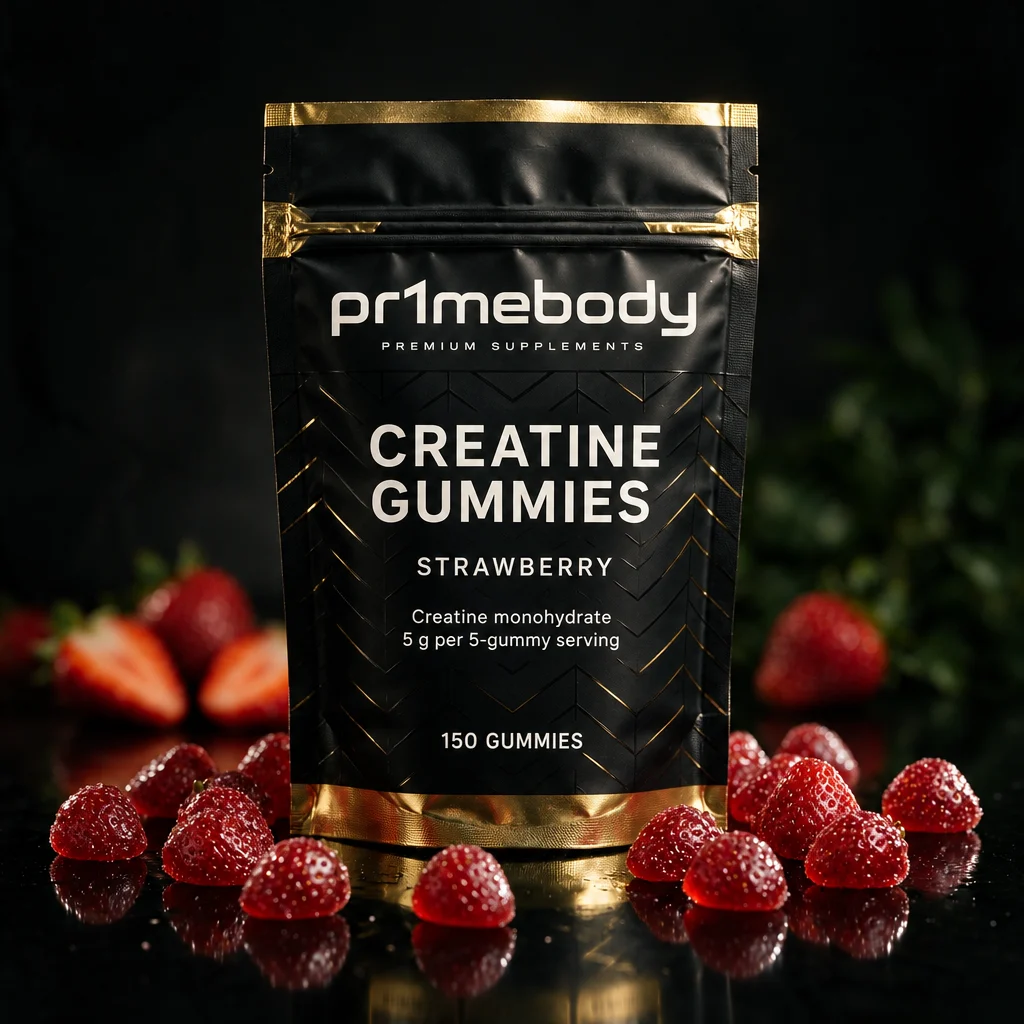
The pr1mebody pouch: strawberry flavour, 150 gummies per bag.
OUR CREATINE GUMMIES
pr1mebody creatine gummies
pr1mebody creatine gummies give 5 g of creatine monohydrate per five-gummy serving. 150 strawberry gummies a bag, 30 servings.
- Creatine monohydrate: 5 g per serving
- Serving: 5 gummies
- 150 gummies per bag, 30 servings
From
$53
1 bag
30 servings · $1.77 per serving
$53
Buy 2, get 1 free
3 bags
90 servings · $1.18 per serving
Standard 3‑bag pack: $120
You save $14
$106
When these are gone, the 3‑bag pack returns to its standard price.
3 bags
90 servings · $1.33 per serving
$120
Save $39
6 bags
180 servings · $1.11 per serving
$199
Save $119
Best value
12 bags
360 servings · $0.92 per serving
$331
Save $305
See the full product page · Read first: creatine gummies explained
Prices in US dollars as of 12 Oct 2026. Free tracked shipping and a 30-day money-back guarantee. Checkout opens on satiovex.com, the store run by Xinop LLC, which also sells pr1mebody products; the item may appear there under the Satiovex name.
The serving maths for our pouch
The label block above gives the printed figures: 5 gummies and 5 g of creatine monohydrate per serving, 150 gummies per bag. The per-gummy figure and the rest of this table are our own arithmetic from them.
Item
Figure
How we got it
Item
Creatine per gummy
Figure
1 g (1,000 mg)
How we got it
5,000 mg per serving divided by 5 gummies
Item
Servings per bag
Figure
30
How we got it
150 gummies divided by 5
Item
Gummies for 3 g
Figure
3
How we got it
3 g divided by 1 g
Item
Gummies for a 5 g day
Figure
5
How we got it
One serving
So a 5 g day means chewing five gummies, and a bag lasts 30 days at that rate. If your target is 3 g, you would chew three and the bag would last 50 days. The listing recommends five gummies a day, any time, with or without food.
We do not publish a laboratory certificate on this site. Until we do, treat the 5 g figure as the manufacturer's label statement, not as independently verified. If a batch certificate matters to you before you buy, ask us for it.
Why show the division at all?
Because "5 g" on a pouch can mean 5 g per gummy, 5 g per serving of ten gummies, or 5 g across the whole bag. Always divide by the serving size.
THE RESEARCH
The ISSN position stand on creatine safety and efficacy is the most cited review of the topic.
How much creatine do studies actually use?
The ISSN position stand on creatine safety and efficacy is the most cited review of the topic. It gives 3 to 5 g a day as the usual maintenance intake, with an optional loading phase of about 5 g four times a day for 5 to 7 days, or a slower route of 3 g a day for 28 days. The European Union's register of authorised health claims ties its performance wording to 3 g of creatine a day for adults doing high-intensity exercise, which is a labelling rule, not a promise of results for you.
Our label says no loading phase is needed, which fits the slower route. Loading at 20 g a day would mean 20 of our gummies, so gummies suit steady daily intake better than loading. The dosage guide lays out every route, a table of gummies needed at different creatine-per-gummy amounts, and how long a bag lasts.
Does the gummy format change how well creatine works?
The answer has two layers. The research on creatine is about creatine, mostly creatine monohydrate powder. The ISSN paper calls creatine monohydrate the most effective supplement of its type for high-intensity exercise capacity and for lean mass gains during training. Gummies are not mentioned in it.
So the question becomes whether a gummy delivers the same compound in the same amount. If it does, there is no known reason the format should matter, because creatine acts in the body, not in the pouch. If the gummy holds less creatine than the label claims, you simply take less than you think.
The same paper says claims that other forms absorb better or break down less are not backed by clinical evidence, and it found none showing better retention than monohydrate. That is useful when a label promotes a fancy form. Ask what the creatine actually is.
Results also vary from person to person. Responses are reported in both sexes, but most studies used men, and some work suggests women may gain somewhat less strength or muscle. Training, food, sleep and consistency matter more than the format of the creatine.
How the two formats compare on cost per gram, convenience and stability is covered in the comparison further down.
Is the creatine in a gummy what the label says?
There is no big peer-reviewed study of gummy creatine content yet. What exists are tests run by supplement companies, which are useful signals but not settled science.
An industry test of 13 gummy brands
NOW Foods ran an industry testing programme on gummies sold with creatine claims, using high-performance liquid chromatography (HPLC). Thirteen brands were tested. Six fell short of their label claims, a 46% failure rate by the article's count. Label claims ranged from 750 mg to 5,000 mg per serving, and from 250 mg to 1,700 mg per gummy. One maker disputes the result and says its own accredited-lab trials found more than the label amount. NOW answers that it tested a single lot.
A second test, six gummies and five powders
SuppCo bought six gummy products and five powders off the shelf and sent them to an ISO 17025 accredited lab. All five powders passed. Four of the six gummies failed on identity and potency, with two showing no detectable creatine. The two gummies that passed carried noticeable creatinine, which the report treats as a sign of some breakdown. The sample is small, picked from the company's own database, and SuppCo sells a rating service, so weigh it accordingly.
Why a gummy might lose creatine
Creatine in solution slowly breaks down into creatinine. A conference abstract on over-the-counter creatine products found that creatine in an acidic solution degraded by about 60% over 28 days at room temperature. That is a solution, not a gummy, so it does not show that every gummy fails. It does show why water, acidity and warmth in a recipe are worth asking about.
Our reading: the format is not doomed, but dose accuracy is a real question that deserves evidence, batch by batch. A seller that cannot say how it checks the creatine in its gummies has not answered the question yet.
TESTING
A page of this kind cannot say which competitor is best, because we have not tested them.
BEFORE YOU BUY ANYTHING
A label checklist you can reuse
Use this on our product and on every other brand. Copy it into your phone if that helps.
- Creatine per serving, in mg or g. It should be stated as the creatine amount, not as a blend weight.
- Gummies per serving. Divide the creatine figure by this number to get creatine per gummy.
- The form. Creatine monohydrate is the form with the research base.
- The total for your target. Count how many gummies you would chew for 3 g and for 5 g.
- Servings per bag. Check that the bag size matches the daily number you would really take.
- Batch evidence. Ask for a certificate of analysis for the batch in your hand, and who ran it.
- Storage and best-before. Heat and damp matter for any gummy.
- Other ingredients. Look for sugars, sweeteners and allergens you want to avoid.
- Who it is for. A responsible label says who should not use it.
A page of this kind cannot say which competitor is best, because we have not tested them. What we can do is give you the questions that sort strong labels from vague ones.
Safety, side effects and who should ask a doctor first
In healthy people, the ISSN paper reports weight gain as the only consistently reported side effect, and early weight gain is largely water. It found no evidence of kidney harm in healthy people in controlled studies, but it advises anyone with pre-existing kidney disease to consult a physician first. Our label also says to consult your doctor if you have kidney conditions or take medication.
Gummies add practical points. They contain sugars or sweeteners, so check the label if you manage blood sugar, and they look like sweets, so store them out of reach of children. The side effects guide goes through weight gain, stomach upset, kidneys and blood tests with the sources.
Ask a doctor or pharmacist first if you
have kidney disease, take prescription medicine, are pregnant or breastfeeding, or are under 18. Supplements are not medicines and do not replace a balanced diet. The NHS notes that most people get the nutrients they need from a varied and balanced diet.
Women, older adults and teens
Creatine monohydrate has been studied in both sexes, though most studies used men. A 2020 systematic review of 29 studies with 951 female participants found no serious adverse events and no significant link to stomach complaints, weight gain or kidney and liver changes, although its authors call for more systematic monitoring. The maintenance range in grams is the same; very small body weight or particular medical conditions are good reasons to ask a professional.
For older adults, the ISSN paper cites meta-analyses reporting greater gains in muscle mass, strength and function when creatine is combined with resistance training. That is a training-plus-supplement finding, not a stand-alone effect.
For teens, our product is not intended for under-18s. Questions such as whether gummies are safe at 14 or 16 deserve a conversation with a doctor, not a product page. The label checklist above applies to everyone.
How to fit them into a routine
Keep it dull and regular. Our listing says five gummies a day, any time, with or without food. The ISSN paper focuses on daily intake over weeks and does not demand a specific time of day, so pick a time you will remember.
- Decide your daily target in grams, between 3 and 5 g for most adults.
- Divide by the creatine per gummy to get the number to chew.
- Take it at the same time each day, with water.
- Keep taking it on rest days. Creatine works through stored levels, not a single dose.
- Store the bag sealed, cool and dry, away from children.
Whatever format you use, stay hydrated and keep to the amount on the label. More is not better, and the research does not show extra benefits beyond the ranges above.
Gummies, powder or capsules?
Gummies are the easiest to take, with no mixing. Powder is the lowest hassle per gram, since a scoop usually holds 3 to 5 g, and it held up better on dose accuracy in the second test above. Capsules avoid taste but often hold only 0.5 to 1 g each, so you swallow several; those figures are typical label ranges, not a measurement of any product. Our gummies vs powder comparison sets out cost per gram, stability and dose per piece side by side.
THE PRODUCT
The pr1mebody pouch
150 strawberry gummies per bag. The label lists 5 g of creatine monohydrate per 5-gummy serving, 30 servings per bag.
Food supplement. Not intended for under-18s. Consult your doctor if you have kidney conditions or take medication.
Questions about creatine gummies
Do creatine gummies work?
Creatine itself has a large research base, mostly with creatine monohydrate powder. Gummies are not covered in the ISSN position stand, so what matters is whether each gummy truly carries the creatine on the label. Dose and consistency matter more than the format.
Are gummies as effective as powder?
If a gummy delivers the same amount of creatine monohydrate, there is no known reason it would act differently. The open question is dose accuracy: two company tests found some gummy brands below their label claim while the tested powders passed.
How much creatine is in one gummy, and how many should I take?
It depends on the brand. Labels in one industry test ranged from 250 mg to 1,700 mg per gummy. Ours works out at 1,000 mg, so 3 g is three gummies and 5 g is five, and the listing recommends five a day. On any label, divide your target by the creatine per gummy.
Are gummies safe to take every day?
Daily use is how creatine is normally studied, and in healthy adults the research reports weight gain as the main consistent side effect. Stay within the label serving. People with kidney disease, those on medication, and anyone pregnant should ask a doctor first, and gummies add sugars and are not for children.
Are gummies a good choice for women?
Creatine monohydrate has been studied in both sexes, but most research has used men, so the evidence in women is smaller. Ask a professional if you have a medical condition.
Should I take gummies before or after a workout?
The research behind creatine centres on daily intake rather than a precise time. Our label says any time, with or without food. Choose a time you will keep.
Do I need a loading phase?
No. The ISSN paper describes loading as one option and a slower 3 g a day for 28 days as another. Our label says no loading phase is required.
Sources
What we could not source: any long-term study of gummy creatine content in peer-reviewed form, and any independent trial comparing gummies to powder in people. We have left those claims out.

Also in the range: Tri-Mag Night, 90 capsules.
KEEP READING
Related reading on creatine gummies
Creatine Gummies Dosage
Creatine gummies dosage with the sums shown: what the pouch directions say, how they sit against the 3 to 5 g a day in studies, and how long a bag lasts.
Read the guide →
Creatine Gummies Side Effects
Creatine gummies side effects sorted by evidence: weight gain, stomach upset, kidney blood tests, and who should check with a doctor first.
Read the guide →
Creatine Gummies vs Powder
Creatine gummies vs powder: how dose per piece, test results, stability and cost per gram compare, plus a worked example from our own label.
Read the guide →
Creatine Gummies UK
Creatine gummies UK guide: what a food-supplement label must show, which creatine claims the GB register allows, plus VAT, duty and delivery.
Read the guide →
Creatine Gummies Canada
Creatine gummies Canada: what a Health Canada NPN means, why we have not published one, the 90-day personal import line, taxes and delivery.
Read the guide →
Product: pr1mebody Creatine Gummies
pr1mebody creatine gummies give 5 g of creatine monohydrate per five-gummy serving, 30 servings per 150-gummy pouch. Label facts and who should ask first.
See the product →
Read the label, then decide
Our pouch lists its figures plainly: 5 g per 5-gummy serving, 150 gummies per bag.