

EVIDENCE READ / ADULTS 18+
Do Spicy Cubes work? We found no trial, so here is the research that does exist
Do Spicy Cubes work? We found no published trial of this product, so we cannot say. What exists is limited research on some of its plants: small, short and mixed, at doses the label does not let you match to one gummy. This page reads that research the way a sceptic should, says where it stops, and lists who should ask a doctor first.
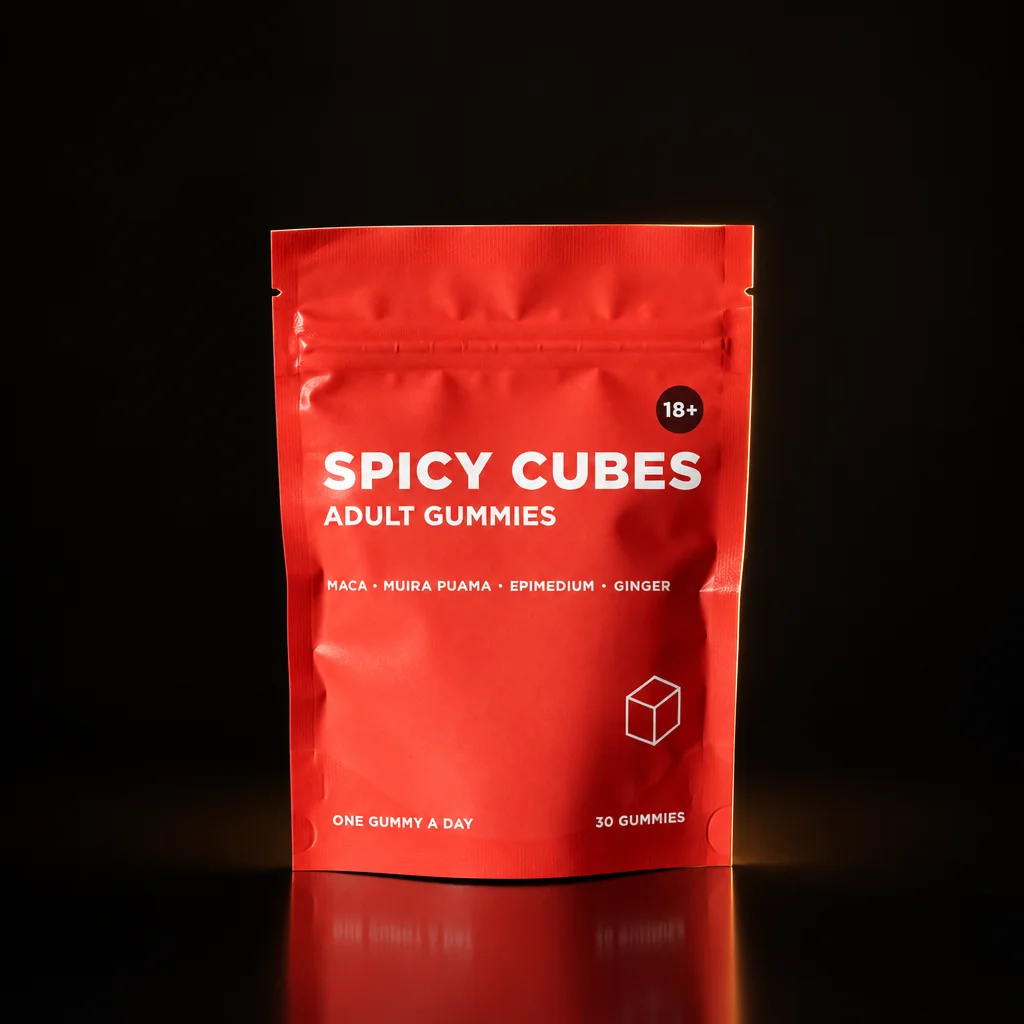
Adults 18+ only. Educational, not medical advice. The picture is an illustrative render: the label, not the picture, is the final word.
Plant studies, not a product trial
30 gummies per pouch, one a day
Adults 18+ only
Ask a doctor first if pregnant, breastfeeding or on medication
Plant studies, not a product trial
30 gummies per pouch, one a day
Adults 18+ only
Ask a doctor first if pregnant, breastfeeding or on medication
The short answer. Do Spicy Cubes work? We found no published trial of this product, so we cannot say. The research that exists covers single plants and other blends, in small, short studies with mixed results. The label facts we publish also leave out the amount of each extract in the 810 mg blend, so a study dose cannot be matched to one gummy.
A note on the name and the seller. This page describes the Spicy Cubes sold through Satiovex and listed on pr1mebody, whose label is summarised in our guide to what Spicy Cubes are. Other companies sell products with the same or a similar name, so compare labels and sellers before relying on any page about Spicy Cubes, this one included. pr1mebody sells Spicy Cubes, so this is a seller's page, not a neutral review (see our editorial policy). Satiovex is the trading name of Xinop LLC, the company that sells pr1mebody products, and we are not affiliated with any other seller of a product called Spicy Cubes.
Do Spicy Cubes work? Start with what the question means
The label facts we publish give amounts, a serving, an age limit and a warning, and name no outcome. So if you ask 'do Spicy Cubes work?', the first reply has to be another question: work at what, measured how? A real answer needs a trial that gives this product to enough people, gives a look-alike with nothing active in it to a comparison group, and measures both on the same outcome.
Do Spicy Cubes work in that sense? We looked for such a trial and found none; the exact searches are at the end of this page. The label in one line: 30 gummies, one a day, and an 810 mg blend with no per-plant weights, with the full label on the Spicy Cubes product page.
OUR ADULT GUMMIES
Spicy Cubes
Spicy Cubes gummies are our adult gummies for adults 18 and over: chili pepper, maca root, muira puama, epimedium (horny goat weed) and ginger root. 30 gummies a pouch.
- Serving: 1 gummy (3 g), 30 per pouch
- Chili pepper 30 mg, maca root 50 mg per gummy
- 810 mg blend of muira puama, epimedium (horny goat weed), maca and ginger extracts
From
$34.99
30 gummies
1 pouch
$34.99 per 30 gummies
$34.99
90 gummies
Buy 2, get 1 free
$23.33 per 30 gummies · you save $34.99
$69.98
Best value
150 gummies
Buy 3, get 2 free
$20.99 per 30 gummies · you save $69.98
$104.97
300 gummies
Buy 5, get 5 free
$17.50 per 30 gummies · you save $174.95
$174.95
See the full product page · Read first: adult gummies guide
Prices in US dollars as of 12 Oct 2026. Free tracked shipping and a 30-day money-back guarantee. Checkout opens on satiovex.com, the store run by Xinop LLC, which also sells pr1mebody products; the item may appear there under the Satiovex name.
The plants on the label, one by one
Do Spicy Cubes work through any one of their plants? No study covers the whole formula, so the fair move is to read each plant's best human evidence with two questions in mind. Was bias controlled? NCCIH says it is surprisingly difficult to avoid bias in clinical trials (NCCIH, minimizing bias). Were the dose and form the same as the product's? NCCIH notes that supplements bought in stores or online may differ in important ways from products tested in studies (NCCIH, using dietary supplements wisely). Maca comes first because the label names it twice, as a root and as an extract.

Illustrative render. Pouch and packaging may differ from what you receive. The label, not the picture, is the final word.
Maca: small trials, mixed results
A 2010 systematic review found four placebo-controlled trials of maca that measured sexual-function outcomes: 131 people in total, 1.5 to 3.5 grams a day, two to twelve weeks. It judged the evidence limited: no trial reported how assignment was concealed or checked that blinding worked, and none assessed adverse effects (Shin and colleagues, 2010). MSK likewise says only a few small trials have been run in people (MSK, maca). The table lists the review's four trials plus one pilot without a placebo group. Each measured a self-rated score, none tested this product, and results were mixed.
Trial
Who and how long
Dose
Score measured
Result
Trial
Gonzales, 2002
Who and how long
57 healthy men aged 21 to 56, 12 weeks, placebo group
Dose
1.5 or 3 g a day of gelatinised maca
Score measured
Self-rated sexual desire
Result
Higher than placebo from week 8 on, in that trial; mood and hormone changes did not explain it. The 2010 review calls it hard to interpret, and none tested this product (PubMed)
Trial
Brooks, 2003
Who and how long
16 healthy postmenopausal women, 6 weeks, placebo group, crossover
Dose
3.5 g a day of dried maca powder
Score measured
Green Climacteric Scale, a menopause questionnaire
Result
Reported higher than placebo (P below 0.05); the review notes no washout between crossover phases (Shin and colleagues)
Trial
Zenico, 2009
Who and how long
50 men with mild erectile problems, 12 weeks, placebo group
Dose
2.4 g a day of dry extract
Score measured
IIEF-5, a questionnaire score for erectile function
Result
Scores rose in both groups (P below 0.05 each) and more on maca, by 1.6 points against 0.5; the authors report that gap as significant (P below 0.001) (PubMed)
Trial
Stone, 2009
Who and how long
8 male cyclists, 2 weeks, crossover
Dose
2 g a day
Score measured
Sexual Desire Inventory
Result
No significant difference between maca and placebo, per the 2010 review
Trial
Dording, 2008
Who and how long
20 adults taking SSRI antidepressants who reported sexual side effects (17 of them women); 10 finished; no placebo group
Dose
1.5 or 3 g a day of maca root
Score measured
Two sexual-function questionnaires
Result
In the 9 people analysed on 3 g, scores moved the way the authors read as a gain (P = 0.028 and 0.017); at 1.5 g, no significant change (PubMed)
Every figure is self-rated, the groups are small, and one trial had no placebo group. A 2026 review adds that many maca studies are small, short and mixed in design, and that recommended intakes vary widely (Wasilewicz and Grienke, 2026). Then there is the dose. Do Spicy Cubes work at the dose in a gummy? The label cannot say. One gummy lists 50 mg of maca root, so a 30-gummy pouch holds 1,500 mg in total, which is what the lowest-dose arm of the desire trial took in one day. The blend adds a maca extract of unprinted weight, so the true total cannot be worked out.
Epimedium: one bone trial and some herbal mixtures
MSK says the scientific evidence for epimedium, also called horny goat weed, is limited and that more studies are needed (MSK, epimedium). A PubMed search on 13 October 2026 for epimedium AND randomized controlled trial[pt] returned 17 records; judging by their titles, most concern bone, joints, lungs, kidneys or other conditions, and several test mixtures of herbs. Two stand out:
- A 2007 trial gave 100 healthy late-postmenopausal women with low bone density an epimedium flavonoid preparation or placebo for 24 months. The daily dose included 60 mg of icariin with two isoflavones, and the outcome was bone mineral density (Zhang and colleagues).
- A 2014 open-label trial gave 49 men a six-ingredient Japanese preparation containing epimedium, or a herbal-medicine comparison, for six months, with no placebo group. It measured an ageing-symptoms questionnaire and the IIEF-5. With six ingredients, epimedium's share of any change cannot be separated (Nishimatsu and colleagues).
One more record, a two-week crossover trial of a Thai herbal product for mild erectile dysfunction, lists no formula in its abstract, so we do not rely on it. A 2026 review of icariin, a compound from the plant, covers animal models of erectile dysfunction and says clinical efficacy still needs confirming in high-quality randomised trials (Meng and colleagues).
Muira puama: animal findings and blends
A 2020 review of the psychiatric and neurological adverse effects of herbs taken for sexual purposes describes no human study of muira puama on its own in its section on the plant, only traditional use and mouse experiments. It reports reduced movement and impaired memory in some of them (Brunetti and colleagues, 2020). Other mouse studies report improved memory retrieval (da Silva and colleagues, 2004), so the animal data point both ways, and neither tells us what happens in people.
A PubMed search on 13 October 2026 for "muira puama" OR muirapuama OR "Ptychopetalum olacoides" returned 51 records, most of them, judging by title, animal or cell experiments or plant chemistry. The oral human studies we found tested mixtures:
- A 2000 study gave a muira puama and ginkgo blend to 202 women for a month, with before-and-after questionnaires; the abstract mentions no placebo group, and the authors called the findings initial and planned a double-blind study (Waynberg and Brewer).
- A 2005 safety study gave healthy volunteers a Brazilian four-herb extract containing muira puama for 28 days and reported no severe adverse reactions; the abstract gives neither the number of volunteers nor each herb's amount (Oliveira and colleagues).
- A 2018 pilot gave 54 men a blend of ginger, muira puama, guarana and L-citrulline. It had no control group; 5 men reported side effects such as dyspepsia, heartburn and migraine, and 16 were still taking part at three months (the abstract gives non-compliance with other erectile medication as the main reason men left) (Nguyen and colleagues).
Do Spicy Cubes work through muira puama? A blend without a control group cannot show which plant, if any, did anything, or rule out expectation, and it says nothing about this product's safety.
Ginger and chili pepper: research on other questions
NCCIH reports research on ginger for nausea and vomiting in pregnancy, motion sickness and knee osteoarthritis, with mixed results, and notes that some studies were not of high quality (NCCIH, ginger). MSK lists chemotherapy-related nausea, period pain, osteoarthritis and chronic low back pain, and says larger studies are needed for the nausea findings (MSK, ginger). For chili pepper, MSK describes small effects on appetite and energy use, and no effect on blood pressure or heart rate in one systematic review (MSK, cayenne). None of these sources gives a study dose to set beside the label's 30 mg.
Putting the plants together
On plant evidence alone the summary is: some small human trials for maca, one bone trial and some herbal mixtures for epimedium, animal data and blends for muira puama, other questions for ginger and chili, and nothing for the combination. So, do Spicy Cubes work? We found no study that says either way.
From single plants to a blend: what carries over
Do Spicy Cubes work as a blend? Putting several plants in one gummy does not add up their studies; it makes a new product whose combination we found no published measurement of. A 2021 review of 32 popular men's supplements found 37 ingredients, horny goat weed among the most common, and 105 randomised trials of those ingredients, yet no published randomised trial of any whole product (Kuchakulla and colleagues).
The amounts are the next obstacle. FDA's labelling guide asks a blend to show its total weight, with ingredients beneath in descending order of weight, and does not ask for each ingredient's own weight (FDA labeling guide, question 34). Muira puama is printed first and ginger last; if the blend follows that rule, that is the only comparison the label supports.
Plant
On the label
Closest study dose, and can it be matched?
Plant
Maca
On the label
50 mg of root, plus a 4:1 extract inside the blend
Closest study dose, and can it be matched?
1.5 to 3.5 g a day (2010 review); 2.4 g of dry extract in one trial. No: the extract weight is not printed.
Plant
Epimedium
On the label
10:1 extract inside the blend
Closest study dose, and can it be matched?
About 60 mg of icariin a day, in a mixed flavonoid preparation, in the bone trial. No: different preparation and outcome.
Plant
Muira puama
On the label
6:1 extract inside the blend
Closest study dose, and can it be matched?
No human dose for the plant alone; blends with unstated amounts. No dose exists to compare.
Plant
Ginger and chili pepper
On the label
4:1 ginger extract inside the blend; chili pepper 30 mg
Closest study dose, and can it be matched?
Not given in the NCCIH or MSK summaries we opened. No.
Expectation, reviews and videos: why feeling better is not proof
Suppose you feel better after a week. Do Spicy Cubes work, then? Not on that evidence alone. NCCIH defines the placebo effect as a beneficial health outcome resulting from a person's anticipation that an intervention will help (NCCIH, placebo effect). It is real, and it is why trials carry a placebo group.
In the maca trial above, the placebo group's scores also rose, by half a point, though the maca group's rose more. A 2020 meta-analysis of the placebo arms of 63 trials of PDE5-inhibitor drugs for erectile dysfunction, 12,564 men in all, found placebo-group scores rose by a small-to-moderate amount (Hedges g 0.35 across the 59 trials in the main analysis). Without an untreated comparison group, the authors could not exclude that some of the rise was spontaneous improvement (Stridh and colleagues).
A Cochrane review of 234 trials comparing placebo with no treatment found no important clinical effects in general, but said placebos can influence what patients report, especially pain and nausea, which is hard to tell apart from biased reporting (Hrobjartsson and Gotzsche). A self-rated score after taking anything can reflect expectation, reporting bias, life's ordinary ups and downs, and possibly the product. A trial pulls those apart; a pouch you buy has none.
Do Spicy Cubes work, according to reviews and videos? They cannot say either. pr1mebody shows no reviews of Spicy Cubes because we have not collected any, and we will not write or borrow any. Two reasons they would not settle it anyway:
- A review or video is one person, one product and one stretch of time, with no comparison group. NCCIH advises scepticism about personal testimonials (NCCIH, general advice from its page on weight-loss supplements).
- Ratings can mislead. A 2019 study of the six top-listed erectile dysfunction supplements on Amazon, which averaged about 2,100 reviews and 3.92 stars, re-ran the reviews through a filtering tool; reviews reporting each benefit fell by 77 to 90 percent. The authors list the few products, selection bias and proprietary software as limits (Balasubramanian and colleagues).
What to take to a pharmacist before the first gummy
The label tells anyone who is pregnant, breastfeeding or taking any medication, particularly nitrates or blood-pressure medication, to ask a doctor first, and it is for adults 18 and over. The product page carries the fuller list of cautions. The sources we read add four points that bear on the plants in this blend.
- Nitrates, blood-pressure medication or a heart condition. MSK says capsaicin may affect how blood-pressure drugs act, tells people with high blood pressure or heart conditions to check with a provider before using cayenne, and advises people with heart disease to avoid epimedium. The label does not say why it names nitrates, and we do not guess.
- Any other prescription. MSK notes possible interactions between epimedium and aromatase-inhibitor drugs, and between ginger and blood thinners, anti-inflammatory painkillers and diabetes drugs, with clinical relevance unknown in several cases. A 2024 review describes one possible maca interaction with an antidepressant, in a man taking several medicines, and says a definite interaction cannot be concluded (Ulloa del Carpio and colleagues).
- A hormone-sensitive cancer. MSK says to talk to a provider about maca and to avoid epimedium or use it with caution, and that maca may interfere with some hormone blood tests. The 2024 review lists one manic episode after maca, in a man with no psychiatric history. Single cases prove nothing, but they are a reason to ask, and anyone who has had mood problems may want to ask too.
- Pregnancy, breastfeeding or trying to conceive. The NHS says to check any medicine with a pharmacist, midwife or GP, and advises against herbal remedies when trying to get pregnant (NHS, medicines in pregnancy). MSK says cayenne should be avoided in pregnancy and while breastfeeding, and ginger supplements too, although NCCIH says ginger supplements in pregnancy may be safe. When sources disagree, ask.
None of this predicts a problem; it tells you what to ask a pharmacist, medicine list in hand. NCCIH notes that what is on a supplement's label may not be what is in the product (NCCIH), and FDA says it does not test dietary supplements before they are sold and has no authority to approve them before they are marketed (FDA questions and answers).
If you feel unwell on any supplement, stop, contact a health professional, and consider telling the manufacturer, as NCCIH advises; in the United States you can also report it through FDA's Safety Reporting Portal. For what the maca research reports, see our guide to maca gummies side effects.
A checklist to judge any supplement
Do Spicy Cubes work for you? A checklist cannot say, but it shows what a fair answer needs, for Spicy Cubes or anything else.
- Look for a study of the product itself, the only direct answer to 'do Spicy Cubes work?'. If there is none, treat everything else as indirect.
- For each plant, find the best human trial, not the best animal study, and note its type, size, dose, group and outcome.
- Check the form and the amounts. A raw root, an extract and an isolated compound are three different things, and a blend that hides each part's weight cannot be matched to a study dose.
- Look for a placebo group. Without one, any change may be expectation or time.
- Check yourself against the warnings, and take your medicine list to a pharmacist.
- Before the first gummy, write down what you expect to notice and what would count as no difference.
Questions readers ask
Do Spicy Cubes work?
We found no published trial of this product, so we cannot say. The research on its plants used other doses, forms and blends and is small and mixed, so for now the honest answer is that we found no measurement of it.
Is there a timeline for Spicy Cubes?
People often ask how long Spicy Cubes take to work. The label facts we publish give no timeline, and this page sets none. The maca trials above ran two to twelve weeks with other preparations; our guide to how long maca takes to work covers what they measured.
Do Spicy Cubes work for men or women?
No study has tested this product in either. The maca trials in the table enrolled mostly men; one enrolled 16 postmenopausal women, and one small pilot enrolled mostly women (17 of 20) who were taking SSRI antidepressants, with no placebo group. None used this formula, so none can answer for it.
Who sells the Spicy Cubes described here?
Satiovex, the trading name of Xinop LLC, which also publishes pr1mebody. We hold no laboratory report for this product, so we can describe the label but cannot verify what is in a single pouch.
Are Spicy Cubes safe for high blood pressure or heart patients?
Ask a doctor or pharmacist first. The label says so for anyone taking blood-pressure medication or nitrates, and MSK tells people with high blood pressure or heart conditions to speak to a provider before using cayenne.
Can I return Spicy Cubes?
Orders placed through pr1mebody carry a 30-day money-back guarantee, with a free prepaid return label; the terms on pr1mebody's shipping and returns page apply. It covers the money, not your health, so stop and ask a clinician if you feel unwell.
Where the evidence stops
Do Spicy Cubes work? Today the honest answer is that we found no measurement of it: no published trial of the product, no human study of muira puama on its own, no study dose for any plant that can be matched to a gummy, and nothing on how these plants interact in one blend. We hold no laboratory report for this product, and we have no customer reviews to show.
The searches behind that were all run on 13 October 2026:
- PubMed, the exact phrase "spicy cubes" in titles and abstracts (run this search): zero records. A looser search without the quotation marks returns two food-science papers, one on ginger oleoresin encapsulation and one on Listeria on roast beef.
- PubMed, maca, epimedium, muira puama and ginger together, using (maca OR "Lepidium meyenii") AND (epimedium OR "horny goat weed") AND ("muira puama" OR Ptychopetalum OR muirapuama) AND ginger: zero records.
- ClinicalTrials.gov, the product name (run this search): zero studies.
They are snapshots, not proof that no study exists, and other sellers use the name. A registered, placebo-controlled trial of this product, in a defined group with a named outcome, is what would let us answer 'do Spicy Cubes work?' with data. We found none.
Studies marked abstract are ones where we read the abstract, not the full paper. This page is educational content, not medical advice.
Sources
1. Shin et al., maca and sexual function, systematic review, 2010
2. Gonzales et al., maca and sexual desire in men, 2002 (abstract)
3. Zenico et al., maca extract in mild erectile dysfunction, 2009 (abstract)
4. Dording et al., maca for SSRI-related sexual problems, 2008 (abstract)
5. Ulloa del Carpio et al., Lepidium meyenii review, 2024
6. Wasilewicz and Grienke, maca as a functional food, 2026
8. MSK, About Herbs: Epimedium
11. NCCIH, Ginger: usefulness and safety
12. Zhang et al., Epimedium flavonoids and bone loss, 2007 (abstract)
13. Nishimatsu et al., six-ingredient preparation with epimedium in men, 2014 (abstract)
14. Meng et al., icariin mechanisms, 2026 (abstract)
16. da Silva et al., muira puama extract and memory retrieval in mice, 2004 (abstract)
17. Waynberg and Brewer, muira puama and ginkgo formula, 2000 (abstract)
18. Oliveira et al., 28-day safety study of a four-herb extract, 2005 (abstract)
19. Nguyen et al., 3-month pilot of a four-ingredient blend, 2018 (abstract)
20. Kuchakulla et al., ingredients in popular men's supplements, 2021 (abstract)
21. Balasubramanian et al., online supplements and their reviews, 2019 (abstract)
22. Stridh et al., placebo responses in drug trials, 2020
23. Hrobjartsson and Gotzsche, placebo interventions, Cochrane 2010 (abstract)
25. NCCIH, Know the Science: minimizing bias
26. NCCIH, Using dietary supplements wisely
27. NCCIH, 6 Things To Know About Dietary Supplements Marketed for Weight Loss (advice on testimonials)
28. FDA, Questions and answers on dietary supplements
KEEP READING
Related reading on Spicy Cubes
What Are Spicy Cubes? Gummies, Not Seasoning
What are Spicy Cubes? Gummies for adults 18+, not seasoning cubes: 30 per pouch, one a day per the label. Who should ask a doctor first.
Read the guide →
Maca Gummies Side Effects
Maca gummies side effects are not well studied. See what human studies and case reports noted, where the evidence stops, and who should ask first.
Read the guide →
Spicy Cubes UK
Spicy Cubes UK: pack prices in pounds, free tracked delivery, how VAT or duty can apply to parcels from abroad, what two UK lists show and the label. 18+.
Read the guide →
Product: Spicy Cubes
Spicy Cubes gummies, 30 per pouch, 18+: the full label, the 810 mg blend with no weights listed, who should ask a doctor first, and pack prices.
See the product →
Read the label, then decide
Do Spicy Cubes work? We cannot say, but the label and the cautions above are there to read before you decide. Spicy Cubes come in a pouch of 30 for adults 18 and over. Checkout opens on satiovex.com. Satiovex is the trading name of Xinop LLC, the company behind pr1mebody.
